Front duct motor cooling design Project

Context
During the 2024-2025 academic year, Oxford Brookes Racing engaged themself in a challenging project to reduce the overall weight of the car in the pursuit of performance. One of the project consisted into the conversion of the frontal electric motor from water to air. A challenging project with high reliability risks and design constraints.
Methodology
The methodology employed for this project was first to set up the specification of the project by listing the temperature and mass flow target set through heat transfer calculation in collaboration with the powertrain department. After this, an overall look at the aerodynamic design regulations was conducted to understand the design opportunities combined with the space limitation set through discussion with the vehicle dynamics department. Finally, a systematic iteration design approach was conducted with aerothermal CFD simulations using RANS and URANS solvers.
Challenges
Design
The major challenges encountered in this project was the available space to place the cooling duct. As the suspension system was not subject to any changes from the previous car iteration, the design needed to be minimalistic to ensure low weight and efficiency. Therefore, to increase the heat exchange efficiency, a heat sink was added to the design to increase cooling area exposure. The heat sink is made out of aluminium and printed in 3D thanks to collaboration with a partner company.

Simulation and testing
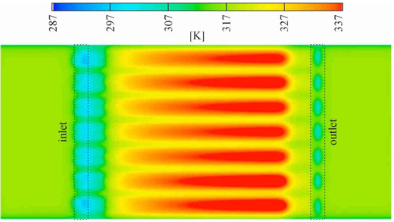
Work inspired from:
https://www.mdpi.com/1996-1073/15/2/536
To validate that our design met the preset specifications, the team first analysed it using CFD aerothermal simulations. As aerothermal simulation was new to all team members, we relied on literature and guidance from alumni to ensure accuracy and to correctly apply RANS and URANS solvers.
Additionally, track testing helped identify design issues, such as gravel protection, and allowed us to correlate real-world results with our simulations.
Communication/Organisation
It took time for the team to fully grasp the scale of the project, the limited manpower, and the tight deadlines. Through careful collaboration and regular meetings between the design and simulation teams, we were able to successfully implement the project on time. The project spanned multiple departments including aerodynamics, powertrain, and suspension, and required weekly coordination to ensure proper collaboration.

Outcomes
Consistent work and effective collaboration allowed us to complete the design and manufacture within tight deadlines for track testing and competition implementation at the FSUK event.
The project culminated in the successful deployment of the design during the FSUK competition, where OBR finished third overall and completed the endurance race without any reliability issues.
Créez votre propre site internet avec Webador